Thody's American Adventures
More of Thody's adventures>
Majesty
and Mortality: It's Good to be Alive in Colorado by Peter Thody
Talk about Colorado and you conjure up images of off-trail skiing, high-altitude hiking and white-water rafting. So it's slightly frustrating that our first few hours in this most outdoors of states are spent negotiating heavy traffic on Interstate 25 in the company of what seems to be every one of the 3 million people (two-thirds of the state's total population) who live, work and commute in and around Denver.
Before too long, though, Fort Collins' rush hour and Loveland's endless traffic signals are behind us and we're heading west toward Estes Park on U.S. Highway 34. We're in another world, one of clean air, cold streams and pine-covered mountainsides. This is more like it. Higher and higher we go, climbing 2,500 feet in 25 miles as the sheer rock walls of Big Thompson Canyon close in on us. This is a beautiful section of road but one with a tragic history. In 1976, freak weather turned the river into a raging torrent, one that swept away everything in its path: cabins, cars, boulders and, yes, people -- 144 of them. We might have viewed the canyon slightly differently had we known this story at the time. As it was, we simply enjoyed what is an incredibly picturesque drive. Arriving at Estes Park, we head straight for the tourist office, where the helpful lady on the desk advises us that there are rooms aplenty on the road into Rocky Mountain National Park. Thirty minutes of painfully slow progress later and it's apparent that she may have passed on this nugget of information to one or two other visitors. Every hotel we reach displays a "No Vacancy" sign so we turn back to look on the other side of town. And when we do come across what could possibly be the last room in the whole of Estes Park ("Mountain view, pool, three nights' minimum; no sir, that's the rate per night, not for all three"), we panic-buy, promising ourselves we'll eat in our room every night. The next morning, of course, we come across a selection of charming-looking, independently-run hotels, all displaying "Vacancy" signs and full of people whose happy smiles say: "Our rooms cost half what yours did and we don't have a fascist server enforcing the rule that no food may be removed from the breakfast room." I pay $193 a night and I can't sneak an apple for lunch? Shame on you, Best Western Silver Saddle, shame on you. But you know what? Within a few miles of entering the park, none of this matters. Not one little bit.
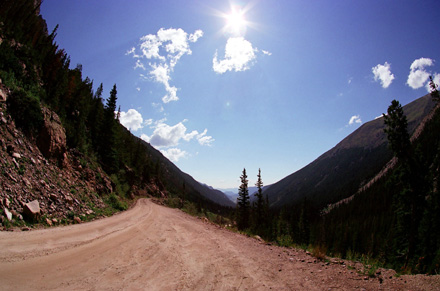
View Wyoming border to Utah border, Colorado in a larger map This is every picture postcard you've ever seen of the Rockies: woodland trails shimmering in the morning sun and mirror-smooth lakes reflecting the snowcapped mountains beyond. Sight isn't the only sense to go into overdrive, either, with the overpowering scent of pine trees and the sound of rushing streams heightening the intensity of the experience. And if ever a road was designed to take you into the heart of it all, it is the Old Fall River Road. Completed in 1920, this nine-mile dirt road was the first motor route to cross Rocky Mountain National Park and it remains pretty much unchanged to this day. The hairpins are as tight and the drop-offs as dizzying as they will have been to the earliest motorists in their Model Ts, but treated with caution it's a drive to be savoured as each new view emerges through the trees. At the end of the road is the Alpine Visitor Center, offering the usual combination of information, education, souvenirs and Coke. There's also a path leading up to a point promising sensational views of the mountains. Every leaflet you pick up around here warns of the risk of altitude sickness, and this short walk, taking us over the 12,000-foot mark, demonstrates how quickly it can hit. Just a few yards from the top, Carole starts to feel distinctly unwell, with the classic symptoms of headache, dizziness and nausea. The only cure is to reach a lower altitude, so we head back down to Estes Park via the gentler but equally spectacular Trail Ridge Road. Over the next two days, we heed the warnings and slow our pace a little. We walk in Upper Beaver Meadows, explore the Bear Lake nature trail, picnic at Sprague Lake, marvel at the hummingbirds, photograph deer and just allow the majestic scenery of the Rockies to wash over us. It really is a very special place. So, if you've got to receive bad news, there's probably nowhere better to be. On our final day in Rocky Mountain National Park, we get a text message from home in England. At the age of 50, one of our oldest friends has died suddenly and, it turns out, unnecessarily. Here's a top tip fellas: If you're not feeling 100 percent, go see a doctor. That's what they're there for. We'd been friends since teenage motorbike days; we'd shared a flat; he was godfather to our younger daughter, Sian; and I'd acted as a character witness when his horticultural activities attracted the attention of the drug squad (he got 18 months). He wasn't the easiest person to get on with - we still exchanged e-mails but hadn't met up since the late 1990s - but over the next few days, Carole and I recalled just what a big part he'd played in our lives. My memories of Rocky Mountain National Park are all happy ones but, looking back at the notes I made as we left and headed west, it's clear that Paul's death put a dampener on things for a while. "Grand Lake is a letdown," I wrote, "a half-finished building site on dusty dirt tracks. Much of the road down to I 70 is pretty much the same." And, "I 70 west travels through what is no doubt wonderful scenery for skiers, but the Swiss-style chalets and ski slopes ripped out of the forest leave me cold." We begin to brighten up a little as we pass the town of Edwards, where the alpine landscape turns into gorgeous red-rock country so suddenly that they ought to put a state boundary there. And the engineering marvel that is Glenwood Canyon really is one of the most stunning sections of interstate in the entire country. But our mood can't do it justice. The next day, after overnighting in Glenwood Springs, we continue west on Interstate 70 as far as Grand Junction, before turning off onto State Highway 141 - the Unaweep Tabeguache Scenic Byway. The first section travels through Unaweep Canyon, an inhospitable landscape of rocky scrubland where signs of human habitation are few and far between. At Gateway we stop for burgers and sodas at the wonderful 141 Diner (which, sadly, now appears to have closed) before moving on to the Tabeguache section of the byway, where sweeping sandstone cliffs follow the path of the Dolores River. It's along here that we chance upon one of the more remarkable relics of 19th-century engineering, the Hanging Flume. Constructed to carry water upstream for use in hydraulic gold mining, this four-foot-deep, five-foot-wide wooden structure was built directly onto the sheer rock face. That this was accomplished without modern construction equipment is impressive enough; that sections remain in place today, though the flume was abandoned in the 1890s, is mind-boggling. Little wonder, then, that the World Monuments Fund has listed the Hanging Flume among its top 100 most endangered sites. For the final section of our westward drive across Colorado, we hit Vancorum and take a sharp right onto State Highway 90, where the canyons disappear, the road straightens and the heat intensifies. It's two-lane highways like this that I dreamt of ahead of this trip: black strips of asphalt blurring and melting in the heat, so little traffic I can set up a tripod on the white stripes and feel my pale, Northern European skin beginning to burn as a truck emerges from the heat haze maybe five miles away. It feels good to be alive and it's a great reminder, if one were needed, of just how lucky we are to be here. Peter Thody More -- Eastern
Utah |
|||||||||||