
Getting
Out There: |
Directory of all "Getting Out There" Articles> |
Road Trip into Arizona's Past
by Robert Schaller
|


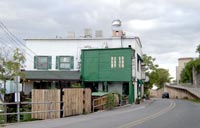


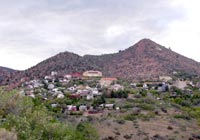
The Army came to evict Civil War Confederates, then later to protect settlers. The first settlers were miners. Mining got its 1850s start in the territory when displaced forty-niners began fleeing the seemingly played-out and overcrowded California goldfields. Arizona and Nevada were among the first stops in an exodus that reached most western states by the time the frontier closed. The Verde Valley is home to the town of Jerome. Four partners started mining a claim on the site, but they encountered difficulties and sold out a few years later to wealthier, more capable mining men such as William Clark of Montana. Under Clark and his partners, Jerome's United Verde Copper Company became one of the most important copper mining centers in the west, and Jerome itself boomed alongside. In the early 1900s, the Jerome mines began to fail, and Jerome began to fade with them. As the mining interests dwindled and pulled out, others flowed in, and a re-born Jerome became a mecca for quirky, eccentric artists and a unique day-trip destination for Arizonans and travelers. While we call it a "ghost city," it never really became one. There were always a few people living there, even in the slimmest years.
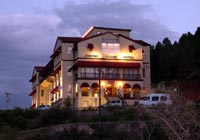
As underground mineshaft fires made things below Jerome unstable, many of the town's buildings slid down the mountainside. Visitors today still marvel at the long route taken by the jailhouse as it slouched its way down the hill. It never made it out of town, but it tried. The remaining buildings cling to the side of Cleopatra Hill and Mingus Mountain, in various states of disrepair or renovation. Visit the mining museum, have a beer at the Spirit Room (if you can find an empty stool) and lunch at the Haunted Hamburger. The Haunted Hamburger, in particular, is worth the wait. The bartender is your host - ask him for a table with a view, or sit outside. Don't forget dessert - the chocolate cake is near perfection and is enough for a table of four. You might stay at the Grand Hotel, which occupies the building that once housed Jerome's hospital. It is reputedly haunted. Legend has it that Pancho Villa once lived and worked as a teamster around Jerome, hauling water up the hill from the valley below. I doubt there is any truth in the story, but you never know.
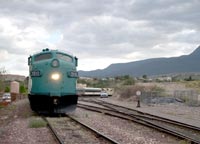
To serve the mines, the railroads came. From a "main line" between Ash Fork and Prescott, a railroad worked its way over and around the north side of Mingus Mountain to provide transportation for Jerome's copper. You can ride some of this roadbed today on the Verde Canyon Railroad. Other sections of the original railroad grade can be driven in 4WD vehicles - inquire locally for directions. The Verde Canyon route through Sycamore Canyon is spectacular. Scenery and wildlife views are almost guaranteed, including an occasional glimpse of the eagles that inhabit the bluffs. While riding along, imagine what this area must have looked like to fur trappers, as they worked the river for beaver in 1830. That year, the nearest hotel bed would have been in Santa Fe. A lot of this land still looks the same today as it did then.
The Verde Valley also attracted settlers who dreamed of farms along the creeks of the red rock country. In nearby Oak Creek Canyon, near Indian Gardens and where Slide Rock State Park is today, you can see where settlers built homesteads along the creek. They grew a number of crops and orchard fruits - apples, pears and peaches. Many of the trees' descendents still produce today and fruit from them is sold in the area - the soil and mild climate are perfect for them.
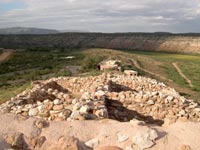
Of course, the first farmers were the Indians - the Sinagua (pronounced "seen-ah-gwa) people lived around the Verde Valley, but disappeared after 1400 AD. Sinagua means "without water." They farmed and raised corn, squash and beans. I can't imagine they didn't live along Oak Creek, as it is a piece of heaven on earth. Some of the other places they lived are still here for us to see. Montezuma Castle (near Camp Verde) and the ruins at Tuzigoot are both good examples and convenient to a Verde Valley traveler. For protection, the Sinagua tended to dwell high on canyon walls or on hilltops. They farmed the lower lands along the creeks and rivers. No one knows for sure why they left or where they went, although their ultimate migration may have been recorded by the oral histories of other tribes, such as the Hopi. It's one of the enduring mysteries of Arizona's past that the Anasazi, the Sinagua and the Hohokam all disappeared about the same time.
Ranching played a role in Arizona's history too, and it's still a part of the picture. In the Verde Valley, you can participate in an evening of "ranch culture" at the Blazin' M. Your meal ticket gets you a western "chuck wagon" supper and a cowboy music show. It's hokey, but that's part of its charm. The music and jokes are first-rate, clean, G-Rated entertainment, which is not something you find every day.
Along with the Blazin M Ranch, the ride across the Rim to Zane Grey country provides a glimpse into Arizona's ranching heritage. Much of the state is still "open range." You will see cattle grazing along many of the roadways. In addition to the historic points of interest, this land is among the prettiest anywhere - and cows love it! You'll see the red rim-rock country, the Verde River valley, the central mountains, the "Rim" and expansive high-desert grasslands along the way.
With ranching, Indian history mixes with white - many of the Navajo and Apache people of Arizona and New Mexico became ranchers as their old ways were lost to them. Herding was a short, compatible step from their original nomadic way of life. The cowboy tradition also had Spanish-Mexican influence. The American cattleman learned his trade and traditions from old Mexico in Texas and carried them north and west with the cattle drives of the 1860s. Now, the original Americans have adopted the cowboy way too. One of the most exciting things to do on a Sunday afternoon in southwest Indian country is to find a local rodeo.
Bob Schaller
December 31, 2006
[Map is on page 3]
More "Getting Out There" Articles>

|
 |
Privacy Policy |
Copyright 1996 - 2025, RoadTrip America® - All Rights Reserved |
Contact RTA |